
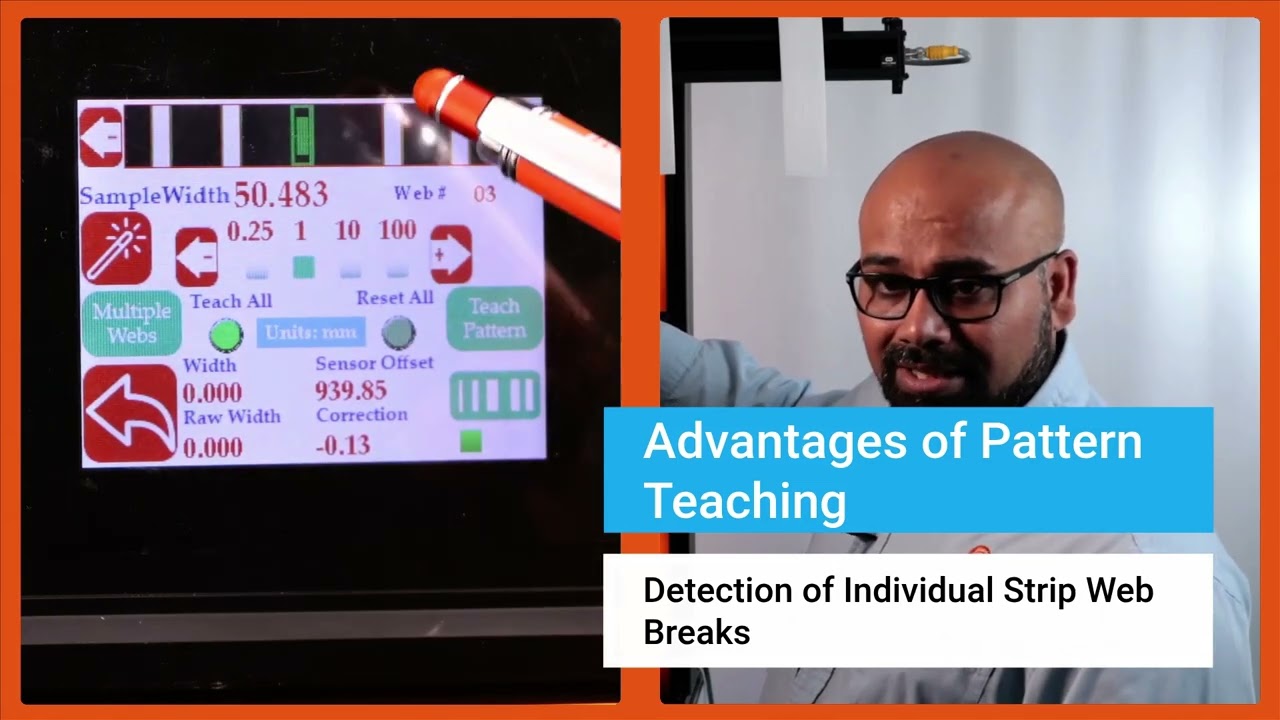
In this episode of the Multiple Web Width Measurement Application Series, we showcase the advanced pattern teaching feature of the SCU6x controller. Learn how to set up widths, samples, and jobs to monitor changes in material movement and width accurately. Discover the advantages of the pattern teaching mode, such as alerting when a web breaks and maintaining precise measurements even with intervening materials.
Transcript
Show full transcript (485 words)
Now we do have another feature that allows you to get even higher um uh uh insight into your process and what that is what we call pattern teaching. So essentially what we will do with the pattern teaching is that we set the widths, we set the samples, we set the job. We're looking for not only the change in the width but also change in the movement of the material. You can enable that by pressing this button that's in the pattern teaching mode.
When you're ready to teach the pattern, we're going to press this teach pattern and press accept. So now the system is taught the pattern. What is the advantage of that? If I have uh let's say I'm in web 3, right?
And if the web three breaks right now, it is actually showing you that hey, I'm supposed to see a web there. It's broken. The value is zero. And it's going to provide an alarm or alert right there.
That's one advantage of that. Another advantage with that is that let's say I have a web five that I'm tracking right here and if I have another material that comes in between there, the web five's measurement is not affected by that whatsoever. In a typical camerabased system, they're going to keep track of the width randomly based on which one is first and which one is second. That would affect the measurement.
If I do have this pattern off, web five will actually jump. You saw that it jumped to that 10 mm and it jumps back. To avoid this jump, we are going to use the pattern. And once the job is set up in your slitter rewinder, it's not going to change.
The pattern is not going to change. Then even if something comes in, that gets completely disregarded. That's the advantage with the pattern teaching or pattern matching mode. Those are the key things with regard to how you can set up our SCS 6x controller for multiple slit width measurement.
Okay, one of the thing that we wanted to show is that this width measurement right now we are in pattern mode. So even in pattern mode, if the web moves back and forth, you can see that the web is moving, but it's also keeping track of that edge position, keeping track of that width pretty accurately. And we can actually move this quite a ways off and that's when it will say that the pattern is supposed to be there, but it has moved from its intended position. So this is an example where let's say the slitter blade moves too much then you can catch that.
Obviously it'll show up in the width but it'll also show up in the web position. As soon as we come back into that location, the actual location itself, then it locks in on that

Setting Nominal Width, Upper and Lower Limits for Multiple Web Width Measurement
Transcript
Show full transcript (798 words)
Then like I mentioned for each web we can set an nominal width, upper limit and lower limit. Right now I'm going to show you how we can set those things. So in order to set the nominal width we're going to press that nominal width icon and then we're going to choose how much increment we want to make. So I'm going to do 10 mm increments here.
So I'm going to change that to 50 mm. Okay. So the nominal width is 49.24. That's it.
There's no need to save anything here. Anytime you change that, that parameter is automatically saved and saved into the memory. So when you power cycle it, it comes back in. Likewise, you can set the upper limit and the lower limit.
So you choose the parameter that you want to change and pick the increment. If I do 1 mm increment that's going to be like that and you can do it like that. It's very simple intuitive way to change it. And likewise you can change those things too.
Now there are applications where we would have two types of outputs. One is to say that if my width is above a certain upper limit or if the width is below a certain lower limit you want to trigger an output there. So in those cases we would have something what we call as that upper limit lower limit kind of thing. So this is a pretty simple setting.
All that we are looking for is hey if the width goes above my upper limit trigger an output or if the width goes below the lower limit trigger another output. So just two boundaries and then within the nominal range the output is not triggered all good signals are provided. If you want an additional layer where you want to set alarm limits and warning limits then we can do that too. So in this particular case then you need to make sure that it is in alarm and warning.
When you have this in alarm and warning you have this button show up just to show you one one more time. If I have it just on upper and lower limit these are the two parameters we can enter. But if we are in warning and alarm there are four parameters you can enter. The first two parameters are here and the second two parameters are warning limits.
warning signal so that you don't have to stop the machine when the warning signal is there. This is just for the operators to know something is getting to get bad and once it hits the alarm limits then you can stop the machine if you wanted to. Just like I mentioned the warning limits are going to be closer to your nominal width and the alarms are typically farther away from there. So in this case we have it set as plus or minus.5 mm and then this is plus or minus.1 mm for that and you can do that for every single web.
You can set the upper limit, lower limit, alarm and warning limits. Right now for web two it's not set up. Web three you can see what is set up there. None of these are set up there.
But that's the way for us to set this up for the alarm and warning so that when the width changes you have the ability to provide a digital output to a stack light or something like that. So that is essentially how to set the multiple width measurement these warnings and alarms. And again just to go through this one more time I'm going to pick width two. I'm going to set that nominal width to be 49 point let's say.5 there.
So I am in warning and alarm. So I'm setting the alarm limits for this. So I'm going to set this as 1 mm and the lower one as 1 mm as well. And alarm I'm going to set this as 0.5 and 0 five for that.
And then you can keep doing that for multiple webs. And if you go back here, you can see for the different values, different webs, you see different values there. When I go from one to another, you got all of these set there. All of these are saved in the memory.
Then you have that option to do it. This is where you use the controller. An operator is manually setting this. All of this can be automated through Ethernet and you can send a recipe to our controller to say web one should be this width.
The upper limit is this and the lower limit is this. Upper warning limit is this and lower warning limit is this and so on and so forth.
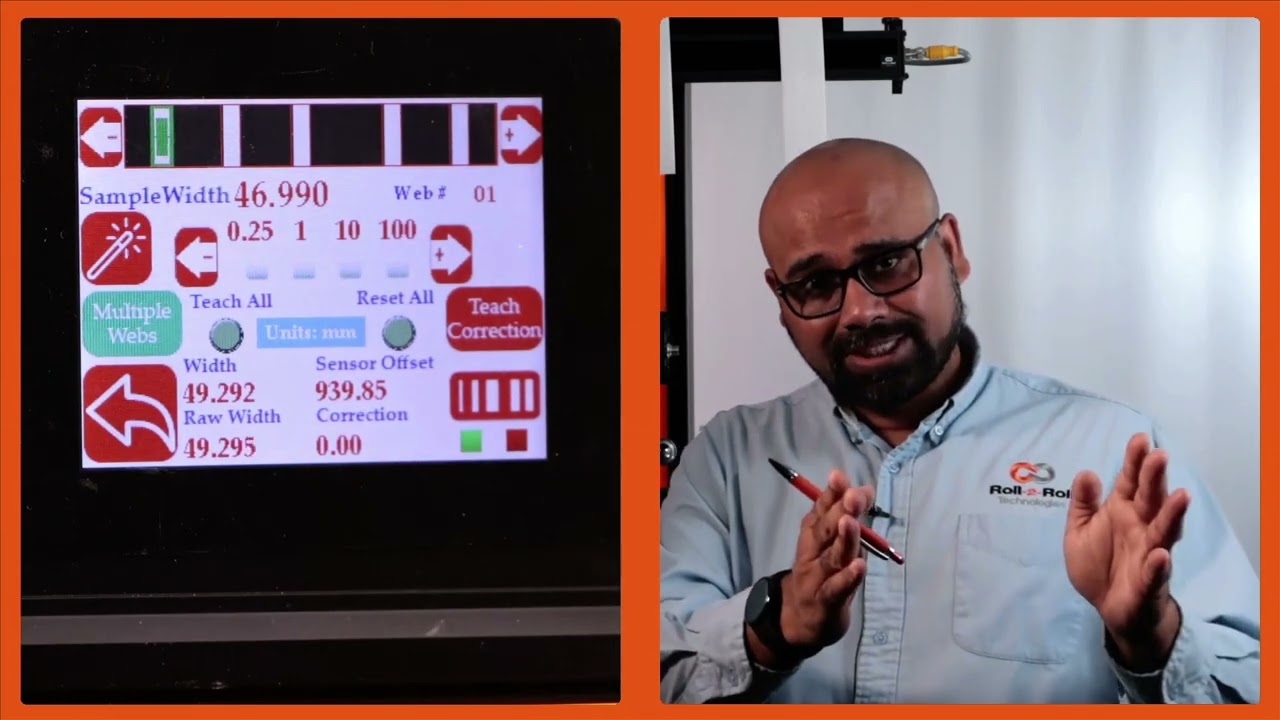
Multiple width measurement is an application that many operations in converting would like to have. Much better if the application was capable of simultaneously measuring and monitoring the widths of several webs. Join Aravind Seshadri from Roll-2-Roll Technologies as he delves into the capabilities of the SCU6X controller and the ODC Family for web width measurement. Learn about the unique advantages of one-sided sensor technology, such as ease of installation in tight spaces and high resolution.
Transcript
Show full transcript (4086 words)
Hello everyone. This is Arvin Shadri from Rollto-roll Technologies. Today we're going to talk about web width measurement with our SCU6X controller. One of the key things with our SCU6X controller and the ODC sensors is that they not only are used for guiding purposes, they're also used for any type of cross machine direction width measurement applications.
It could be measuring the width of a single web or multiple webs. Here again to reiterate on some of the advantages of the ODC sensor is that it's a one-sided sensor technology. So it allows us to install the sensor in tight installation spaces whereas a camerabased traditional machine vision system might need a long longer field of view and working distance which creates issues if you want to add an width measurement system to an existing machine. The other advantage is that the light source, the optics and the camera, everything is built into a single interface like what we have here.
We don't have to have a separate light source or gantry to have the camera and the light source built in. The third advantage is that the sensor provides a one:one magnification. If the object is 100 mm wide, we're using a sensor that is at least 100 mm wide. So, we get a 1 one magnification.
The advantage is that when you go to a wider width, you don't lose any resolution. So for example, this ODC 960 which is a measuring range of 960 mm can provide the resolution of 127 micron on the camera level and then sub pixel with that you could get up to about 33 micron resolution. your resolution is not affected by the field of view that you are requiring. Because of these advantages, the ODC sensor is used for a lot of different applications, especially in existing sliver rewinders where you want to measure the width of the material.
Today, we're going to talk about something that is unique to our solution to measure multiple widths with the same system. The advantage of this is that because it's one-sided, we can have multiple webs ranging from one web all the way up to 32 webs per sensor. So that's what we're going to discuss a little bit. We're going to talk more about how this can be set up in the controller interface and then we'll also look at in another video how you can get the data out and what you can do with the system.
Okay, I've got this controller set up right now the home screen on this. The first and foremost thing that we're going to do with the SEO 6X is basically kind of pick the application. SEO6X is a pretty versatile controller. It can be used for a lot of different applications.
So in this case, I'm going to set it up for width measurement application. Could be a single web width or multiple web width. And once we do that, we can go into the sensor screen. Right now, I have just one sensor connected here, but we can connect multiple sensors.
In another video, we'll talk about how we can have multiple sensors either with a gap between them or an overlap between them so that we can stitch the image of two sensors into a single continuous image. In this video, we're just going to look at how to do this with a single sensor. So, I have this connected to sensor one and then you can see all the samples there. Any setting in this is going to be very similar to what we have done in the past with the SC6X controller in terms of setting the brightness, the contrast and all those things.
We would ask you to refer to the previous videos to learn more about that. In this case, we have a pretty good image already done. So, we'll just go into that operator width screen to take a look at the functionalities and what we can do there. To get to the operator width screen, from the home screen, we're going to press the tools icon, then the operator icon on the top right, and then the width icon.
This first page is the operator width home screen. The second page is an additional setup screen where you're able to do more setup related things. We'll cover both these screens in this video. So in the first screen you can see that it is providing you with a lot of different things.
First it's showing you the width of the web and then the web number. And if you want to go look at the width of the next web, press that icon. It'll go to web two and it's going to show you the width of the web there. And you can keep scrolling through basically how many webs you have.
You can go through these two icons on the top allow you to scroll through the webs. In this case, we are looking at multiple webs. For each web, we can set an upper limit, a lower limit, and a nominal width. The units are in millimeters.
If we change the units to inches, then everything will show up in inches. So, just to show you how this will work in inches. You can go back couple of one screen and then go to the display icon in the operator menu. And then the units, you can change it to inches.
And now the units on this screen will all be on inches. Then like I mentioned for each web, we can set an nominal width, upper limit, and lower limit. Right now I'm going to show you how we can set those things. So in order to set the nominal width, we're going to press that nominal width icon.
And then we're going to choose how much increment we want to make. So I'm going to do 10 mm increments here. So I'm going to change that to 50 mm. Okay.
So the nominal width is 49.24. That's it. There's no need to save anything here. Anytime you change that, that parameter is automatically saved and saved into the memory.
So when you power cycle it, it comes back in. Likewise, you can set the upper limit and the lower limit. So you choose the parameter that you want to change and pick the increment. If I do 1 mm increment that's going to be like that and you can do it like that.
It's very simple intuitive way to change it. And likewise you can change those things too. Now there are applications where we would have two types of outputs. One is to say that if my width is above a certain upper limit or if the width is below a certain lower limit you want to trigger an output there.
So in those cases we would have something what we call as that upper limit lower limit kind of thing. So this is a pretty simple setting. All that we are looking for is hey if the width goes above my upper limit trigger an output or if the width goes below the lower limit trigger another output. So just two boundaries and then within the nominal range the output is not triggered all good signals are provided.
If you want an additional layer where you want to set alarm limits and warning limits then we can do that too. So in this particular case then you need to make sure that it is in alarm and warning. When you have this in alarm and warning you have this button show up. Just to show you one one more time.
If I have it just on upper and lower limit these are the two parameters we can enter. But if we are in warning and alarm there are four parameters you can enter. The first two parameters are here and the second two parameters are warning limits. warning signal so that you don't have to stop the machine when the warning signal is there.
This is just for the operators to know something is getting to get bad and once it hits the alarm limits then you can stop the machine if you wanted to. Just like I mentioned the warning limits are going to be closer to your nominal width and the alarms are typically farther away from there. So in this case we have it set as plus or minus.5 mm and then this is plus or minus.1 mm for that and you can do that for every single web. You can set the upper limit, lower limit, alarm and warning limits.
Right now for web two it's not set up. Web three you can see what is set up there. None of these are set up there. But that's the way for us to set this up for the alarm and warning so that when the width changes you have the ability to provide a digital output to a stack light or something like that.
So that is essentially how to set the multiple width measurement these warnings and alarms. And again just to go through this one more time I'm going to pick width two. I'm going to set that nominal width to be 49 point let's say.5 there. So I am in warning and alarm.
So I'm setting the alarm limits for this. So I'm going to set this as 1 mm and the lower one as 1 mm as well. And alarm I'm going to set this as.5 and 0 five for that. And then you can keep doing that for multiple webs.
And if you go back here, you can see for the different values, different webs, you see different values there. When I go from one to another, you got all of these set there. All of these are saved in the memory. Then you have that option to do it.
This is where you use the controller. An operator is manually setting this. All of this can be automated through Ethernet and you can send a recipe to our controller to say web one should be this width. The upper limit is this and the lower limit is this.
Upper warning limit is this and lower warning limit is this and so on and so forth. So just to reiterate this is the procedure for somebody to set up a job. If you want to have all of these alarm warning limits you can set for individual webs and then set them up. to make it simple.
If you have a recipe or a job number, you can automate this by setting these through Ethernet if you wanted to. One other thing we need to do whenever we are initially setting up is u one-time calibration procedure that can be done on this screen. The idea for this is that we have the ability to calibrate our sensor for your conditions. We do have a calibration done in the factory, but when it's being installed, the sensor might be installed at a different distance than what we typically expect.
And then there are other things with the lighting and contrast that might change some of these parameters. So this calibration is necessary only if you're looking for a higher resolution measurement. For example, if you're looking for a tolerance of plus orus 1/16th of an inch, you don't need to do any of these calibration things. But any anytime you are below that.
So anytime you're below a millimeter or below a 1/16th of an inch resolution, you would need to do a calibration. This is done just for that particular setup. Once you do it, you don't have to do it for the rest of the run. It'll be stored and take that calibration value.
What does the calibration do? Essentially, I have a material or a sample of a known width and the sensor is providing a raw measurement. We're going to compare those two and then say the calibrated measurement is based on the actual sample width and whatever the raw offset is, that's the correction we're going to use for the rest of the measurements. So, that's indicated here.
So that's basically saying what is the correction from the actual width to the measured width. That's essentially what the calibration is. So it's just creating a offset. So for example, let's say the sample width is 46.
To change that, you press whatever you need to increment by and change that value. I am going to put that as 49.244. Right now it's measuring 49.293. If I want to teach this, my sample width should match my measured width.
To do that, press this teach icon and then press accept. Now it has applied a correction. Essentially the raw width plus this correction gives me my actual width. And that's pretty simple.
It's just a regular bias or correction that we are adding. Nothing fancy about this calibration. So you can do that for all these other materials. We don't necessarily need to do this if your tolerance is 1/16th of an inch or 1.5 mm.
We don't need to do that. But for some customers looking for a higher resolution, you do that calibration procedure. Now, just to make it simple, you can enter all of these sample widths already and then you can do a one-time teaching. Let me show you how that works.
I'm going to enter this sample width here. Okay. So, if I want to do all of them together, I'm going to press this teach all button. Make sure that it's highlighted.
And then I'm going to press this teach and accept. Now, all these samples will have a correction. Before we had everything as zero. And if I now scroll through web 5, web 4, web 3, web 2, and web 1, all of them now have a correction.
So it's just a quick way for you to do this. The general use case for this is that let's say you are a customer in automotive or medical and you have a QC process where you are only sampling a part of your product. You're setting up your slitter. You pull the initial sample after the operator has set up the slitter and you take that sample and you're doing a QC on that.
Now essentially what you're going to do is take that sample and enter it like what I have here. Then you're going to do a teach all. Once that is done during any part of the run, we are taking that measurement online in line 100% of the time. So that's the biggest advantage with this system.
In your typical process right now, you might be doing one sample at the beginning of the run. At the end of the run, the operator needs to stop the machine, take that sample, give it to QC, take the measurement, and then everything is good. You run it, and then every time the machine is stopped, there is another sample that is taken. So, this is a random sampling process with a lot of time involved between one run to another.
and we completely eliminate that and allow you to keep running the machine and monitor the width all the time. So that's the biggest value proposition with our system and that's essentially it. So that will allow you to calibrate each of these samples and be done with it. Now we do have another feature that allows you to get even higher insight into your process and what that is what we call pattern teaching.
So essentially what we will do with the pattern teaching is that we set the widths, we set the samples, we set the job, we're looking for not only the change in the width but also change in the movement of the material. You can enable that by pressing this button. That's in the pattern teaching mode. When you're ready to teach the pattern, we're going to press this teach pattern and press accept.
So now the system is taught the pattern. What is the advantage of that? If I have uh let's say I'm in web 3, right? And if the web 3 breaks right now, it is actually showing you that, hey, I'm supposed to see a web there.
It's broken. The value is zero and it's going to provide an alarm or alert right there. That's one advantage of that. Another advantage with that is that let's say I have a web five that I'm tracking right here.
And if I have another material that comes in between there, the web f measurement is not affected by that whatsoever. In a typical camerabased system, they're going to keep track of the width randomly based on which one is first and which one is second. That would affect the measurement. If I do have this pattern off, web 5 will actually jump.
You saw that it jumped to that 10 mm and it jumps back to avoid this jump. We are going to use the pattern and once the job is set up in your slitter rewinder, it's not going to change. The pattern is not going to change. Then even if something comes in that gets completely disregarded.
That's the advantage with the pattern teaching or pattern matching mode. Those are the key things with regard to how you can set up our SCS 6X controller for multiple slit width measurement. Okay, one other thing that we wanted to show is that this width measurement right now we're in pattern mode. So even in pattern mode, if the web moves back and forth, you can see that the web is moving, but it's also keeping track of that edge position, keeping track of that width pretty accurately.
And we can actually move this quite a ways off and that's when it will say that the pattern is supposed to be there, but it has moved from its intended position. So this is an example where let's say the slitter blade moves too much then you can catch that. Obviously it'll show up in the width but it'll also show up in the web position. As soon as we come back into that location the actual location itself then it locks in on that.
For customers that are looking for really high resolution measurement and high accuracy measurement. We also have other features to compensate for the installation of the sensor. In the previous section, I talked about the brightness, the contrast and all those kind of things. But on top of that, if you want to get a really high resolution measurement, then there are a few other things that we can compensate for.
One of the compensation is for how the sensor is aligned with respect to the machine. Obviously, we want the sensor face to be parallel to the surface of the web and we want the sensor to be at a certain distance from the web. But it can be installed at an angle and even small angles make a big difference in the measurement. So the example would be if I have a sample that is straight but if I put it at an angle then I'm looking at the essentially it's basically a cosine kind of thing.
So you are adding more to the width than that. So there is an issue with how the web is presenting. Ideally the camera it's it's just a line but you have two sensors in there. So there are two rows.
So we want the web to be perpendicular to the two rows that we have. Now it's impossible for somebody to install it exactly perpendicular. So we have that compensation available there. So I will show you how we can take care of that.
So when you first install the system and you want to compensate for the angle, the way to do that is that we can go into the power user screen and from there you would be able to set this up. So to get there, click on the tools icon bottom right power user and then go into the sensor. You can see that sensor one and it's identifying as ODC960. This is the number of pixels it has and all those kind of things.
There are actually 10 cameras in there. So for these high resolution measurement when you when we set this controller up on the back of that sensor, we will have a factory calibrated string of 10 numbers that you need to enter. So it will vary between five and 15. For each one of them, it'll be a number.
You can pick that number and whatever that number says you can set that number there by moving the upper and lower numbers. That's the first thing we need to do. The second thing we need to do is compensate for the angle. So that that is another thing that we have in documentation that you can look at and it will tell you what that number means.
There is a small measurement that you need to make when you do the first installation. And once you have that, that number you're going to come in and enter in that last column. These two things are necessary if you're looking for a measurement resolution of sub mm, actually sub 250 micro. Anytime you want that high of a resolution, we need to make sure we have these things set up.
This is a factory calibration number that you need to enter. The slope correction is another number you need to enter in this screen. When we do multiple click width measurement and we have a digital output that triggers an alarm limit or a warning limit, you can tie that to a stack light. If you have multiple web widths, multiple split widths, then if any one of them is out of the range, then those stack light would get triggered.
So we have one output for alarm, one for warning, and one for all good. And if any one of those lanes violate that condition, you will have that digital output get triggered. Just to show you how that works. Um, I don't have a stack light connected, but I do have a signal that would go out when that happens.
And you can see that information on the SCU6X controller. So that's what I'm going to show. In order to get to that screen, press the tools icon on the bottom right and then the arrow key on the bottom right and then digital IO. We want to make sure that the digital output is set for width.
And then you can see a real-time view of what the three outputs are. Right now I've got output three enabled because everything is as per the tolerances. So if I move or change the width of this material, you can see that it it triggers that alarm when that width changes. So if I have something that is narrower, you got that those are the alarm limits and walling warning limits that gets triggered.
So like I said it could be any any lane and that will provide the visual output for the operator to know there is a warning or an alarm doesn't tell you what lane it is. When we get this data through Ethernet then you would have information about exactly which lane has the problem and what kind of an alarm that we have in there. So we'll look at that in the next video. Just to summarize, in this video, we looked at how to set up a single sensor for multiple slit width measurement where you can set it up just directly on the SCU6X controller.
And we also saw how when you connect to a digital stack light, when the width of any of these lanes go above or below the limit, then you have the ability to trigger that stack light. In the next video, we'll look at how we can collect this data through the Ethernet and what are the functionalities that we have through Ethernet. And we'll also look at the app that we have and the app, the data that we can collect from the app and so on and so forth. So, please follow and subscribe to our channel and we'll see you in the next video.