
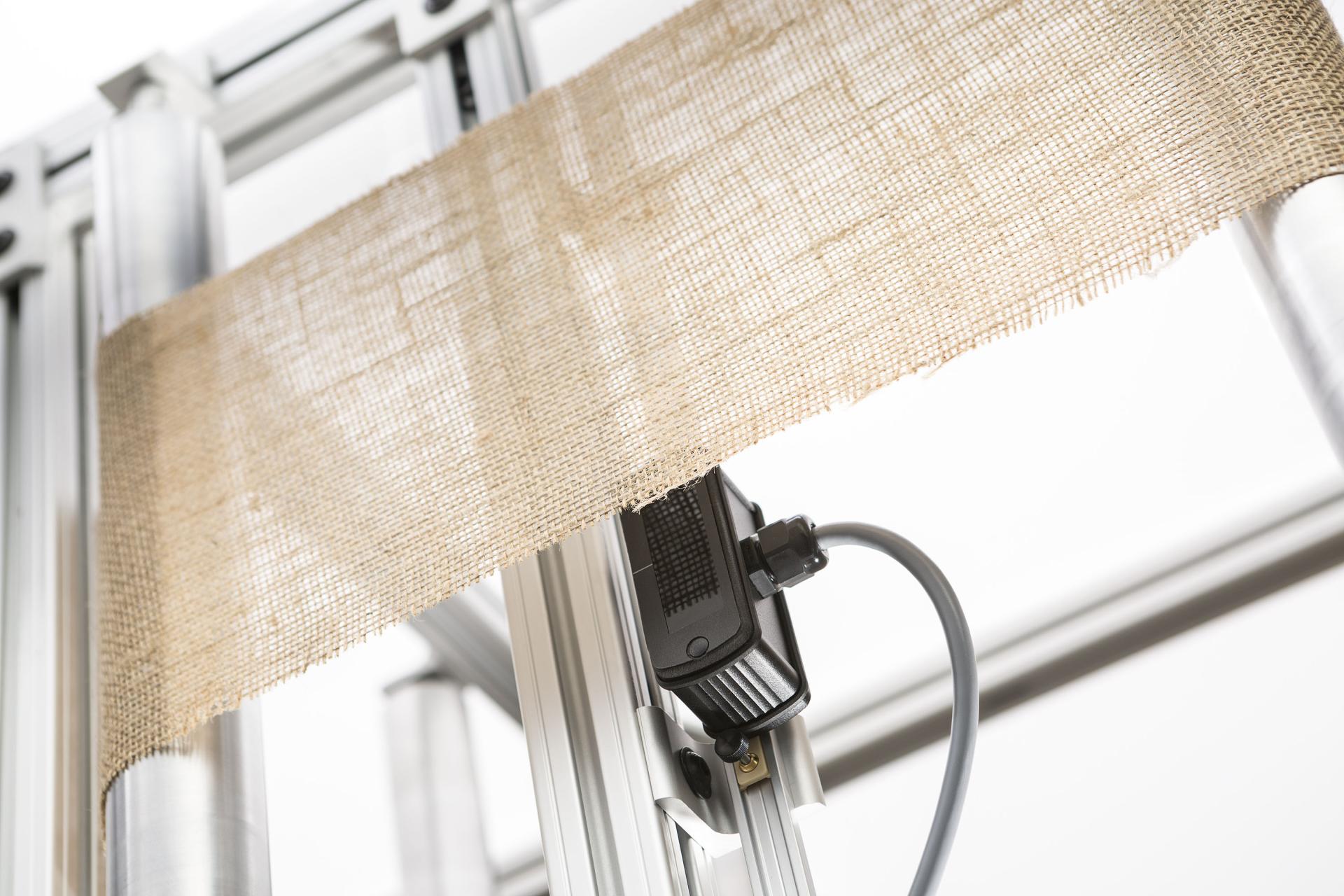
Edge Detection and Position Measurement
Edge detection and position measurement is the foundation of automated web handling. Roll-2-Roll Technologies provides fiber-optic sensors that detect web edges on any material—clear films, porous nonwovens, metallic foils, glass, mesh, and abrasive materials—without recalibration. Unlike traditional photoelectric or ultrasonic sensors that struggle with material variations, our sensors use patented light scattering technology to deliver reliable edge position data regardless of opacity, porosity, or reflectivity.
The Challenge: Why Traditional Edge Sensors Fall Short
Traditional edge sensors rely on blocking a signal—infrared light or ultrasonic sound—to detect the web's presence. This creates critical limitations:
- Material Dependency: Clear films allow light to pass through. Porous nonwovens allow ultrasonic sound to pass through. Each material type requires sensor recalibration or switching to a different sensor technology entirely.
- Setup Time Waste: Operators must manually adjust gain, teach contrast points, or swap sensors during material changeovers. A 15-minute changeover becomes a 30-minute ordeal.
- Vacuum Incompatibility: Ultrasonic sensors cannot function in vacuum environments—no air means no sound waves. This limits options for glass manufacturing, coating processes, and semiconductor applications.
- Vision System Complexity: Camera-based alternatives require separate light sources, gantry systems, and vision experts to program—adding weeks of integration time and ongoing specialist costs.
The Roll-2-Roll Solution: 1D Camera Without Complexity
Roll-2-Roll® Sensors are essentially one-dimensional line scan cameras—but without the complexity of traditional machine vision systems:
| Traditional Machine Vision | Roll-2-Roll Technologies Sensors |
|---|---|
| Requires separate light source | Integrated LED illumination |
| Needs gantry/mounting systems | Single-sided, compact form factor |
| Requires "vision expert" to program | Operators set up with zero code |
| Complex calibration procedures | No calibration needed |
| Weeks of integration time | Setup in minutes |
How It Works
- Projects Light: An integrated LED array illuminates the web from one side
- Captures Scattered Signature: A patented fiber-optic array acts as a spatial filter
- Creates a 1D Image: The sensor generates a one-dimensional picture of the web edge
The Result: The sensor sees the structure of the web—its physical edge—regardless of whether it's opaque, clear, porous, or reflective. This is a major unlock: sophisticated imaging capability that operators can set up with no lines of code.
Technical Specifications
| Specification | ODC Family | 1DC Series |
|---|---|---|
| Sensing Ranges | 48, 96, 192, 288, 384, 480, 768, 960 mm | 96, 192, 288, 384, 480, 768, 960 mm |
| Hardware Resolution | 0.0635 mm (48-288mm) / 0.127 mm (384-960mm) | 0.0635 mm (0.0025 in) |
| Repeatability | ±0.127 mm (±0.005 in) | ±0.127 mm (±0.005 in) |
| Linearity Error | <0.25% | <0.25% |
| Response Time | 20 ms standard (1 ms available) | 20 ms standard (1 ms available) |
| Max Edges Detected | 128 | 128 |
| Min Edge Spacing | 2 mm (0.08 in) | 2 mm (0.08 in) |
| Working Distance | 15-25 mm standard | 15-25 mm standard |
| Operating Temperature | -10°C to 65°C | -10°C to 65°C |
| Vacuum Compatible | YES | YES |
| Controller Required | Yes (SCU5 or SCU6x) | No (built-in) |
| Industrial Protocols | Via controller | EtherNet/IP, PROFINET, EtherCAT, Modbus/TCP |
Key Benefits
- Zero Changeover Time: No manual recalibration between materials—switch from clear film to metallic foil instantly
- Eliminate Calibration Errors: No teach mode, no gain adjustments, no operator-dependent settings
- True Spatial Awareness: 0.0635 mm resolution and ±0.127 mm repeatability, not just binary on/off
- Wide Viewing Area: Up to 960mm sensing range covers full web width without repositioning
- Single-Sided Installation: Fits in tight spaces where C-frame sensors cannot
- Vacuum Operation: Works in vacuum environments where ultrasonic sensors cannot function
- No Vision Expert Required: Operators set up and run the system with zero code
Cost of Inaction: What You're Losing Today
Every week you continue with legacy edge sensors, you're accumulating hidden costs:
Hidden Costs (Uncounted but Real)
- Calibration Labor: 2 hours monthly at $60/hour = $1,440/year per line
- Extended Changeovers: 2 extra minutes × 5 changes/day × 250 days × $1,000/hour machine rate = $41,700/year
- Troubleshooting Time: 4 hours/month diagnosing drift-related issues = $2,880/year
Risk Costs (Probability × Impact)
- Quality Escapes: Undetected edge drift causes coating misregistration—potential recalls or rework
- Equipment Damage: Missed edges lead to web wraps, bearing damage, production stops
Opportunity Costs (Revenue You're Not Capturing)
- Material Limitations: Can't run clear films, mesh, or specialty materials your competitors handle
- Speed Constraints: Slow sensor response forces reduced line speeds
- Lost Contracts: Can't bid on work with tight edge tolerances
Typical Annual Cost of Inaction: \$25,000 - \$75,000 per line
Applications Across Industries
- Battery Manufacturing — Detect electrode foils with 0.0635mm resolution for precise coating alignment
- Converting & Packaging — Guide multiple material types without recalibration between changeovers
- Nonwovens & Hygiene — Guide porous materials at speeds up to 760 m/min (2,500 fpm)
- Glass Manufacturing — Detect glass edges in vacuum environments (used by major glass manufacturers)
- Film Extrusion — Measure layflat width on blown film lines, including clear films
- Label & Printing — Detect clear labels on clear liners without special setup
- Pharma & Medical — Guide multiple materials with data logging for regulatory compliance
Product Options
ODC 96 Family
Best for: End users who want easy setup with touchscreen interface
1DC 960 Series
Best for: OEMs and technical users who prefer Ethernet/PLC interfaces
- All-in-one sensor (no external controller)
- Direct Ethernet connectivity
- EtherNet/IP, PROFINET, EtherCAT, Modbus/TCP
- Sensing ranges: 96-960mm
Related Solutions
- Edge Guiding — Automated web alignment using edge position
- Web Width Measurement — Continuous width monitoring
- Splice Detection — Automated splice and defect detection