
In this episode of the webinar series on web guiding fundamentals, we delve into the critical aspects of steering guides. Learn why it's crucial to maintain a 90-degree angle on the plane of motion to avoid twisting and bending in the web span. Discover the ideal range for raceway angles and the importance of considering web stiffness and entry span length during installation. Proper installation processes are key to minimizing errors and avoiding the common pitfalls that can lead to increased costs and amplified inaccuracies. Stay tuned for essential design considerations and practical tips to ensure optimal performance of your steering guides.
00:00 Introduction: What Not to Do
00:09 Understanding the Plane of Motion
01:05 Wrap Angles and Design Considerations
01:37 Installation Challenges
02:15 Advantages and Cost Considerations
02:26 Potential Issues and Amplification of Errors
Transcript
Show full transcript (467 words)
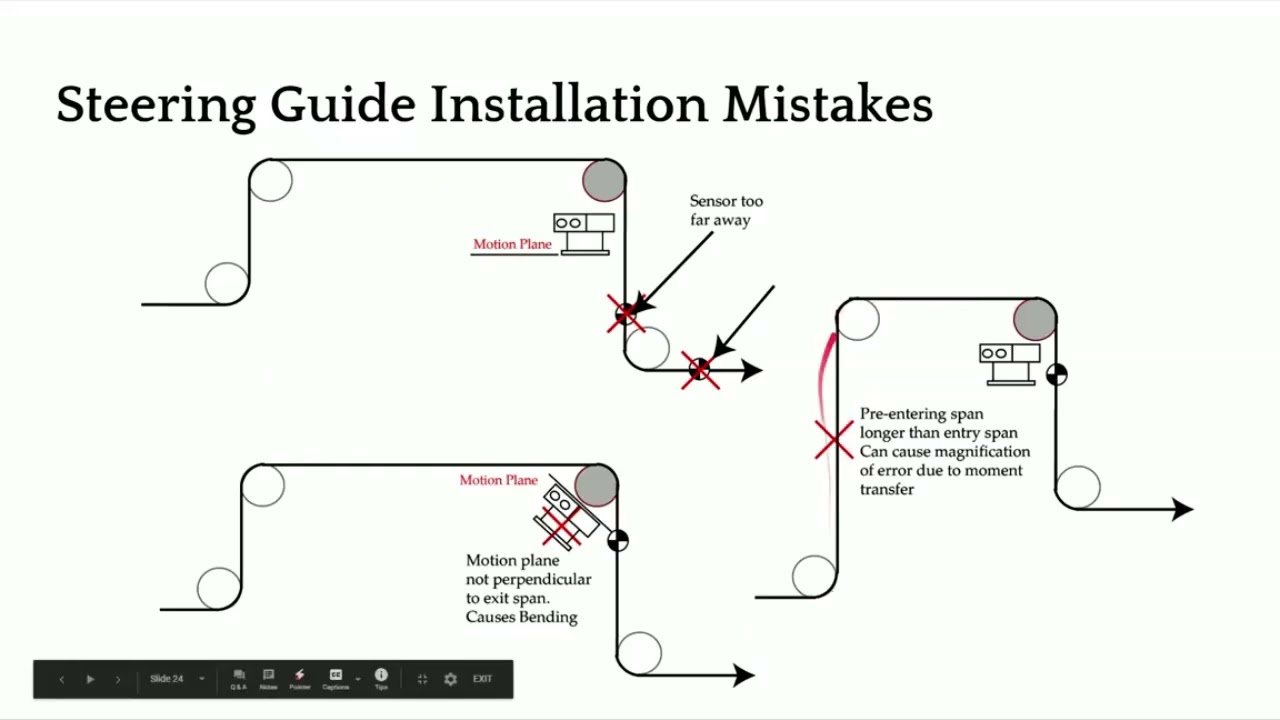
[Music] Now, what not to do? Same thing. We don't want to put the sensor too far away. One of the things that is not really evident is that we don't want to put the plane of motion of the web guide at anything other than 90°.
It's not this angle between the entry and the exit span that needs to be 90°. It's actually the angle of the plane of motion of the web guide and the exit roller. That's what determines whether you're going to have a twisting action or not. When you have something like that, you're going to introduce bending in the span.
And when you start bending a short span, it's not a good sign. So, we don't really want to do that. So, that's the main reason why we need to have the plane of motion perpendicular. Not really the entry and the exit span, but the plane of motion.
And then like I mentioned, if you have the entry span and the pre-entry span longer than the entry span, then you could have moment transfer happening. That's something that you don't want to do either. In terms of wrap angles, pretty simple. You can have something going up like that or going down like that.
As long as we follow this condition, that exit span is perpendicular to the plane motion, then we are in good shape. Just to summarize the design consideration, design correction is one of the main things there. And the raceways that we have on the steering guides, we don't want to angle them more than 25°. So anywhere between 5 to 20° would be the ideal one.
In terms of installation, steering guide is a lot more complicated to install. You have to consider the stiffness of the web, the entry span length. You need to make sure that you're not putting too much bending stress on the web based on how stiff your web is, the location of the instance center, which depends upon the raceway angle, depends upon the length of the entry span. So, there are lots of things to consider for proper installation of a steering guide.
These web guides are prone to have a lot of issues because they're not properly installed. In terms of advantages, they're they're simple, so they're cost effective. It's just a single roller. So, it's inexpensive, but it comes with other things that increase the overall cost of ownership.
It's hard to install. A lot of attention to detail is required, especially because of the bending and things like that. Loss of traction or anything like a moment transfer occurring can actually amplify the error. So, a poorly installed or poorly designed steering guide can actually produce error, more amplify the error than than what it's intended to do.
[Music]